How to edit an instrument's settings in Flat
Last updated October 30, 2026
An instrument in Flat is the configuration behind a part: its staves and clefs, its transposition, its tablature and tuning, its playback sound, and its name. Flat provides more than 100 instruments and lets you change the settings of each one from the Instruments tab of the editor, without leaving your score.
Where are the instruments of my score?
The Instruments tab in the left panel of the editor lists every part of your score, in score order. Click ⋯ next to a part to show its three actions: the pencil edits its settings, the arrows replace its instrument, and the bin removes it. You can also click a part name on the score to edit its settings.
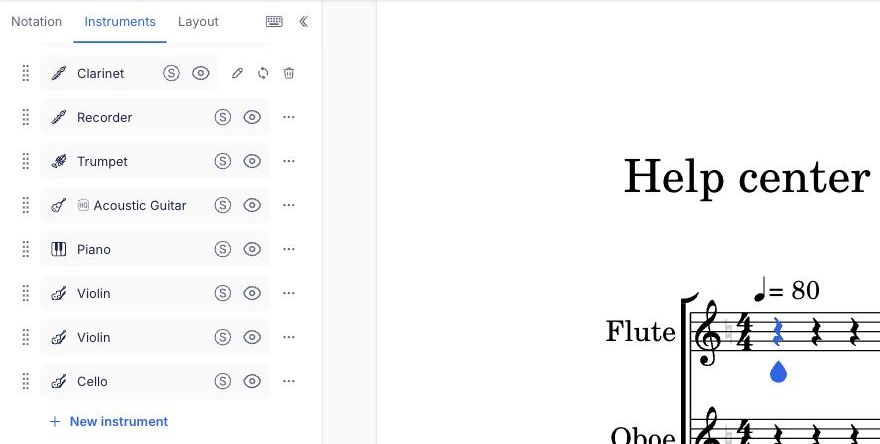
Changing the line-up of the score, such as adding, removing, replacing, or re-ordering parts, is covered in how to add, remove, replace, or re-order score parts. Brackets are edited directly on the score, and instrument sorting puts the parts in the standard order of an ensemble.
How do I edit an instrument's settings?
In the Instruments tab, click ⋯ next to the part and then the pencil, or click the part name on the score. The settings of the instrument open in the left panel, grouped in categories, with a preview of your score on the right. Each change applies to the score as soon as you make it.
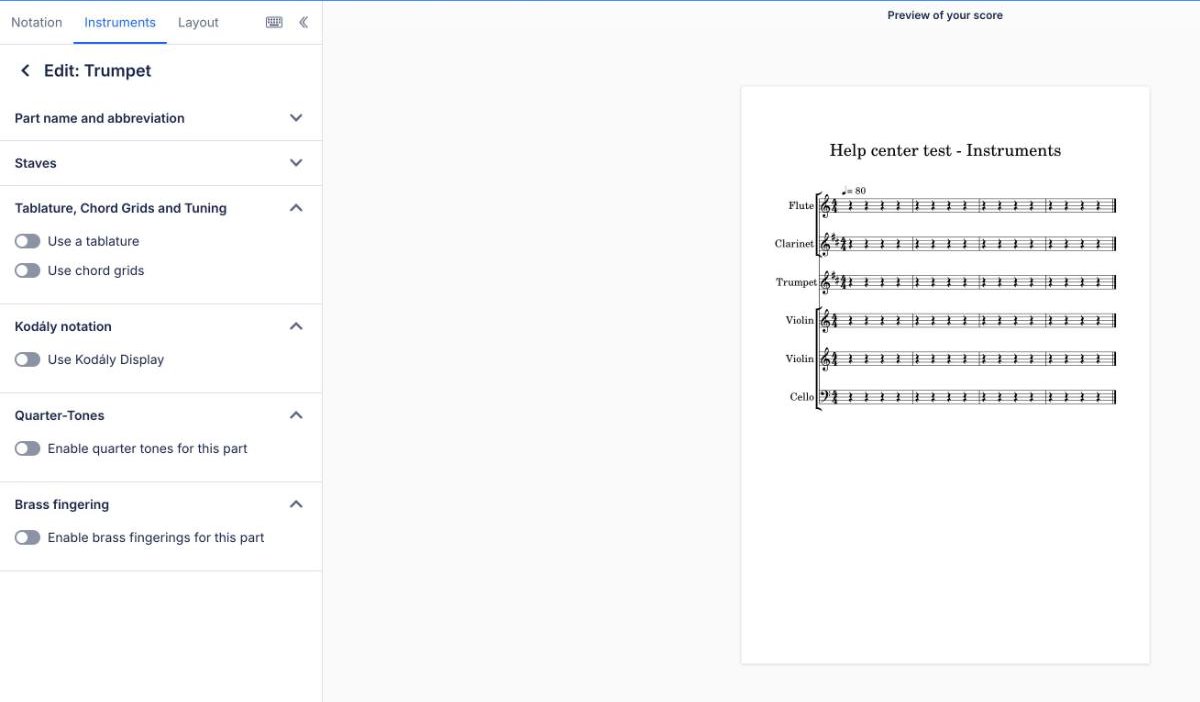
Only the categories that apply to the instrument are listed:
| Category | What you set | Learn more |
|---|---|---|
| Part name and abbreviation | The name printed on the first system and the abbreviation on the next ones | Rename a part |
| Staves | Add a staff to the instrument or remove one | Add or remove staves |
| Tablature, Chord Grids and Tuning | The tab, its number of strings, tuning, and capo, and the chord grids | Tuning and capo |
| Kodály notation | Solfege letters or hand signs under the part | Kodály notation |
| Quarter-Tones | The quarter-tone accidentals for this part | Quarter-tones |
| Brass fingering | Valve numbers for the notes of a brass part | Brass fingerings |
| Recorder fingering | Fingering diagrams for the notes of a recorder part | Recorder fingerings |
A part shows either a tablature or Kodály notation, not both: turning one on turns the other off.
There is no save button: Flat applies and saves each change with the score as you make it. Click the back arrow next to Edit to return to the list of parts.
Tablature, Chord Grids and Tuning, Kodály notation, Quarter-Tones, and Brass fingering are included with Flat Power. Part names and staves can be edited on every plan.
How do I choose instruments when creating a score?
When you create a score, Flat asks for its title, then opens a window to add its instruments. In Choose instruments, open a family or type in the search field, and click an instrument to add it; use + next to it to add another part of the same instrument. The instruments you pick appear under Your score, in the order they will have in the score, and you can drag them to change it.
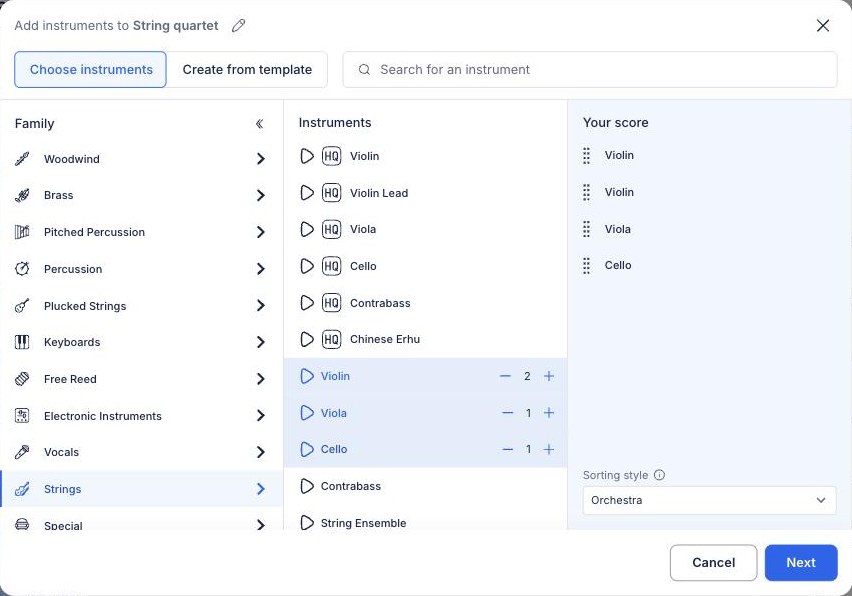
Click Next to set the tempo, key signature, time signature, and number of measures, then click Create Score. Every instrument can still be changed afterwards.
With Flat Power, the Sorting style menu under Your score places each instrument in the standard order of the ensemble as you pick it.
What are instrument templates?
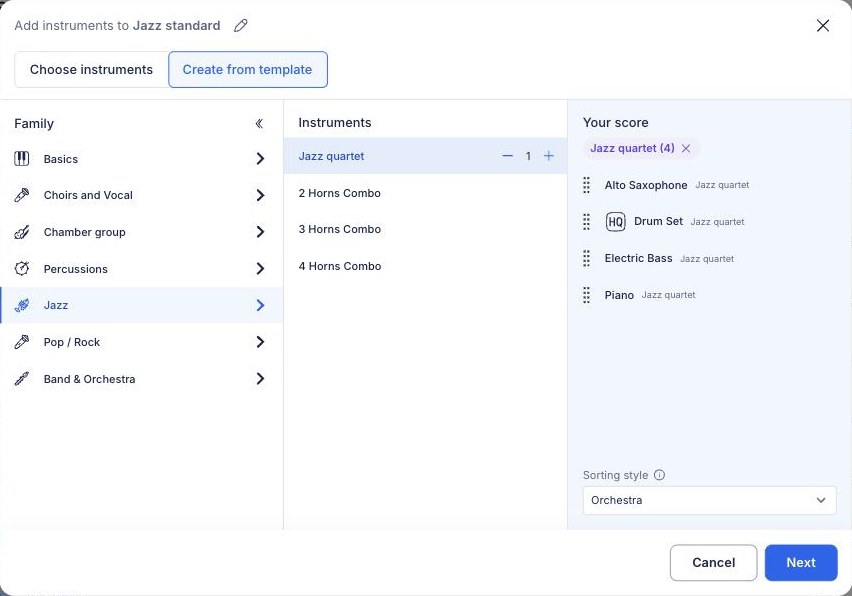
Instrument templates are ready-made instrumentations, from a jazz quartet to a choir or a concert band. When you create a score, open Create from template, choose a family such as Jazz or Choirs and Vocal, and click a template: all its instruments are added under Your score at once. You can still add or remove instruments before you create the score.
Can I save my own instrument configurations?
Yes. A custom instrument saves a complete configuration, such as staves, clefs, transposition, tablature, tuning, sound, and name, in your Flat account, so you can add it to any score instead of setting it up again. In the Instruments tab, click Edit next to Custom instruments under Advanced options to create and manage them.
Frequently asked questions
Do I need to save my changes to an instrument?
No. Flat applies each change to the score as soon as you make it - a new name when you leave the field, a staff when you add it - and saves it with the score. The preview on the right shows the result, so you can check it before going back to the list of parts.
How do I turn a part into a tablature?
Edit the instrument, open Tablature, Chord Grids and Tuning, and turn on Use a tablature. The same category is where you choose the tuning and the capo. Because the tab is synced with the notation, enabling it on a part that already has music generates the tablature from what is written.
Do I have to configure the same instrument setup for every new score?
No. Save it once as a custom instrument and it becomes available whenever you create a score or add a part. Instrument templates cover the opposite case - a whole pre-selected instrumentation for a genre, chosen in one click.