How to add up and down bow markings in Flat
Last updated September 17, 2026
Bow markings in music notation indicate how a string instrument, like a violin or cello, should be played. They provide instructions on whether to play a note with an up-bow or a down-bow, influencing the musical expression and phrasing. Flat adds them to the note you select, and removes them when you click the same icon again.
What are up and down bow markings?
Bow markings in music notation indicate how a string instrument, like a violin or cello, should be played. They provide instructions on whether to play a note with an up-bow or a down-bow, influencing the musical expression and phrasing. Writing them out removes any doubt about how a phrase should be attacked.
How do I add a bow marking?
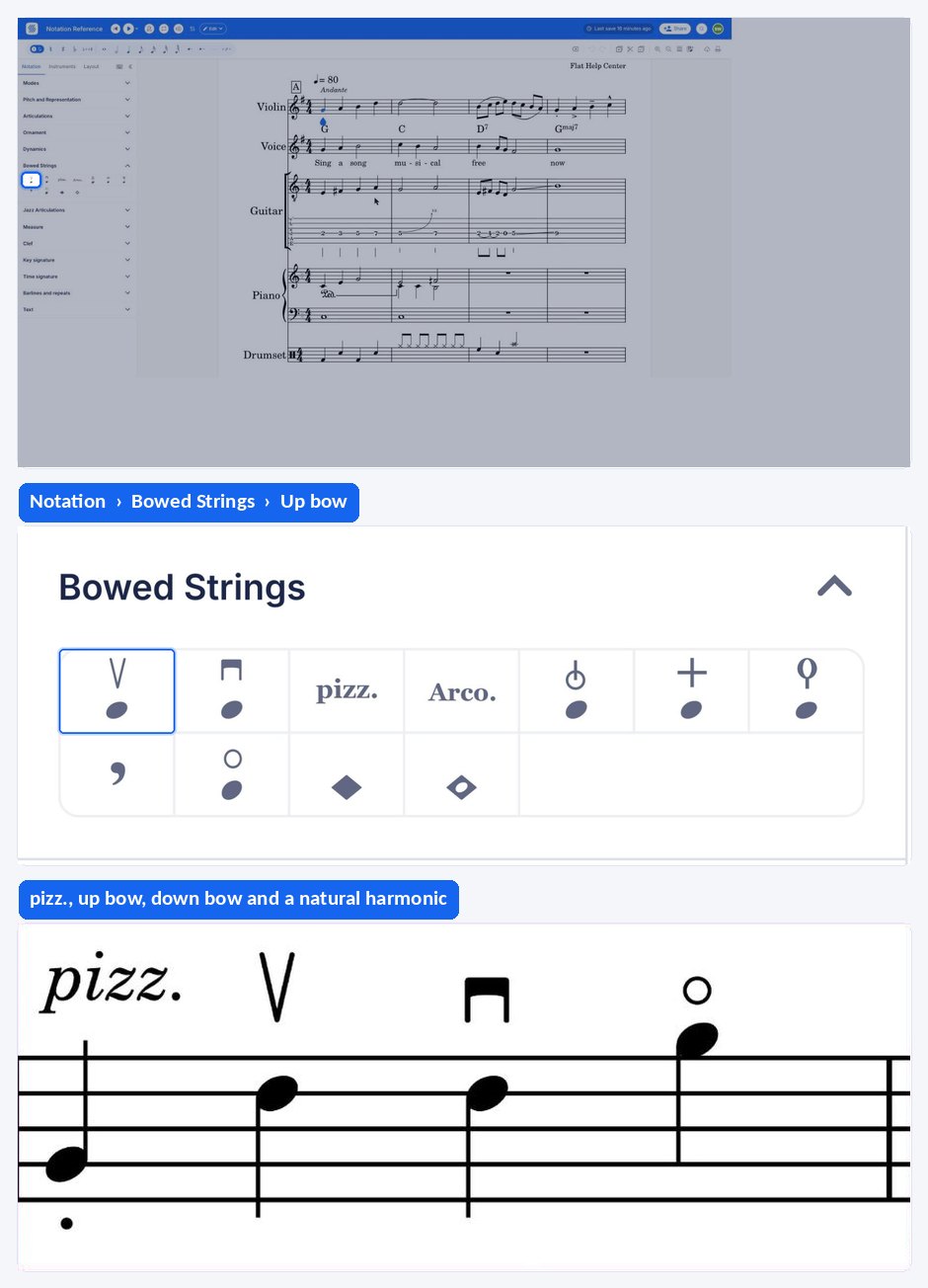
Select a note, then open the Notation tab in the left panel and click the bow icon you want under Articulations. If you change your mind, simply click again to remove it.
What are up and down bow markings?
Bow markings in music notation indicate how a string instrument, like a violin or cello, should be played. They provide instructions on whether to play a note with an up-bow or a down-bow, influencing the musical expression and phrasing. Writing them out removes any doubt about how a phrase should be attacked.
How do I add a bow marking?
A bow marking is applied to the note you select, and it is a toggle - applying the same marking again removes it.
Select the note, drag the tool palette up, and tap the bow mark you want under Bowed Strings - the section that gathers the string techniques the left panel keeps under Articulations on the web. Tap it again to remove the mark.
Frequently asked questions
What is the difference between an up bow and a down bow?
They are the two directions the bow travels. A down-bow is drawn from the frog towards the tip and is normally the stronger, heavier stroke; an up-bow travels back towards the frog and is lighter. Marking them tells the player exactly which stroke each note should get.
Which instruments use bow markings?
Bowed string instruments - violin, viola, cello, and double bass. The markings tell that player how to draw the bow, so they are not used on wind, keyboard, or plucked parts, where the notation instead carries breath marks, pedalling, or picking indications.