How to add pedal markings in Flat
Last updated September 23, 2026
A pedal marking in Flat shows where a player presses and releases the damper pedal, so every note between the start and end markings is sustained. Flat writes pedal markings from the Dynamics section of the Notation panel for compatible instruments, and lets you move and resize each marking afterwards.
Where is the pedal button?
The pedal tool sits in the left panel, in the Notation tab, under Dynamics. Place the cursor where the pedal goes down, then click the button — or press its default keyboard shortcut, P.
| Feature | Location | Icon | Default Keyboard shortcut |
|---|---|---|---|
| Pedal | Notation > Dynamics |  | P |
What is a pedal marking?
Pedal markings indicate the use of the damper pedal (also called sustain pedal) for compatible instruments (the most famous of them being the piano). In effect, all the notes between the pedal start and pedal end markings will be sustained. Once the pedal end marking is reached, the pedal is released and all the sustained notes which aren't playing at this time will stop sounding.
How do I add and edit a pedal marking?
The pedal marking tool is available in the Dynamics section of the Notation panel. Place the cursor where the pedal goes down and click it: a pedal marking is added from the cursor location to the end of the measure. From there you can move it or change how far it reaches.
Please note that the tool will only be displayed for compatible instruments, which are, at the time of writing, the whole Keyboards and Pitched Percussions categories.
The pedal marking has the ability to be moved horizontally along the part through drag and drop. It can also be shrunk or expanded using one of the two round handles on both extremities of the marking.
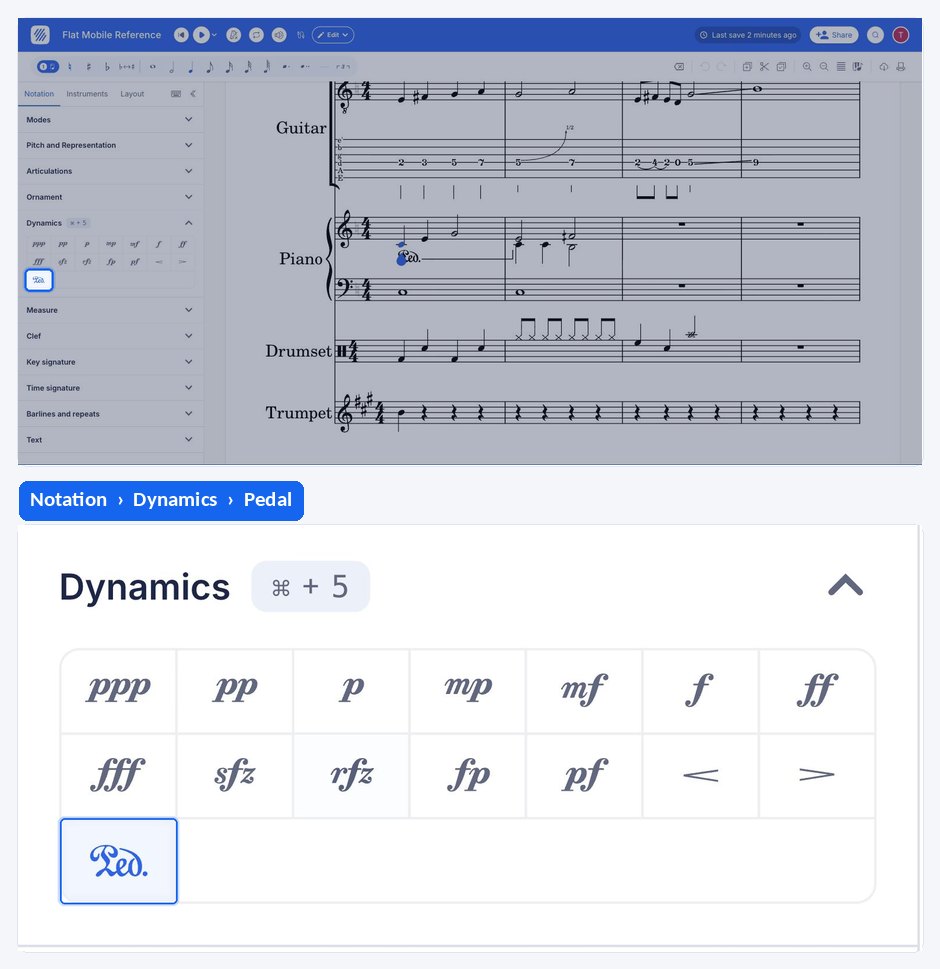
Finally, a pedal marking can be removed either by clicking the pedal marking button in the left panel while the cursor is in the marking range, or while the pedal marking is directly selected, by using the "Delete" shortcut on the keyboard or using the button in the panel.
Where is the pedal button?
The pedal tool sits in the Dynamics section, and is only shown for compatible instruments.
| Feature | Icon |
|---|---|
| Pedal | |
What is a pedal marking?
Pedal markings indicate the use of the damper pedal (also called sustain pedal) for compatible instruments (the most famous of them being the piano). In effect, all the notes between the pedal start and pedal end markings will be sustained. Once the pedal end marking is reached, the pedal is released and all the sustained notes which aren't playing at this time will stop sounding.
How do I add and edit a pedal marking?
Please note that the tool will only be displayed for compatible instruments, which are, at the time of writing, the whole Keyboards and Pitched Percussions categories.
Select the note where the pedal goes down, drag the tool palette up, and tap Pedal under Dynamics - not under Text, despite the name. The marking runs from there to the end of the measure, and you can drag its end to change how far it reaches.
Frequently asked questions
Can a pedal marking span more than one measure?
Yes. Flat adds the marking from the cursor location to the end of the measure, but the two round handles at either extremity let you expand it across further measures or shrink it back. Drag the right-hand handle to the point where the pedal should be released.
What happens to the notes when the pedal is released?
Once the pedal end marking is reached, the pedal is released and all the sustained notes which aren't playing at this time will stop sounding. Notes still being held by the player continue as written; only the ones kept alive by the pedal are cut off.