How to add pizzicato and arco markings in Flat
Last updated September 23, 2026
Pizzicato in Flat is an articulation that tells a string player to pluck the notes with the fingers instead of bowing them, with arco marking the return to the bow. Flat writes pizz., arco, and left-hand pizzicato markings from the Bowed Strings section of the Notation panel.
Which pizzicato markings does Flat offer?
Flat writes three markings for plucked string playing, all in the left panel under the Notation tab, in the Bowed Strings section. Select a note first, then click the marking you want.
| Feature | Location | Icon |
|---|---|---|
| Pizz | Notation > Bowed Strings |  |
| Arco | Notation > Bowed Strings |  |
| Left Hand Pizzicato | Notation > Bowed Strings |  |
What is a pizzicato?
Pizzicato is a playing technique for bowed string instruments which produces a short and percussive sound. When played, the notes should be plucked with fingers instead of bowed. Arco indicates the end of Pizzicato.
How to add a "pizz."/"arco" notation?
Select a note, then open the Notation tab in the left panel and click Pizz or Arco under Bowed Strings. Flat writes the text above the staff at the selected note, so the player knows where to start plucking and where to pick the bow back up.
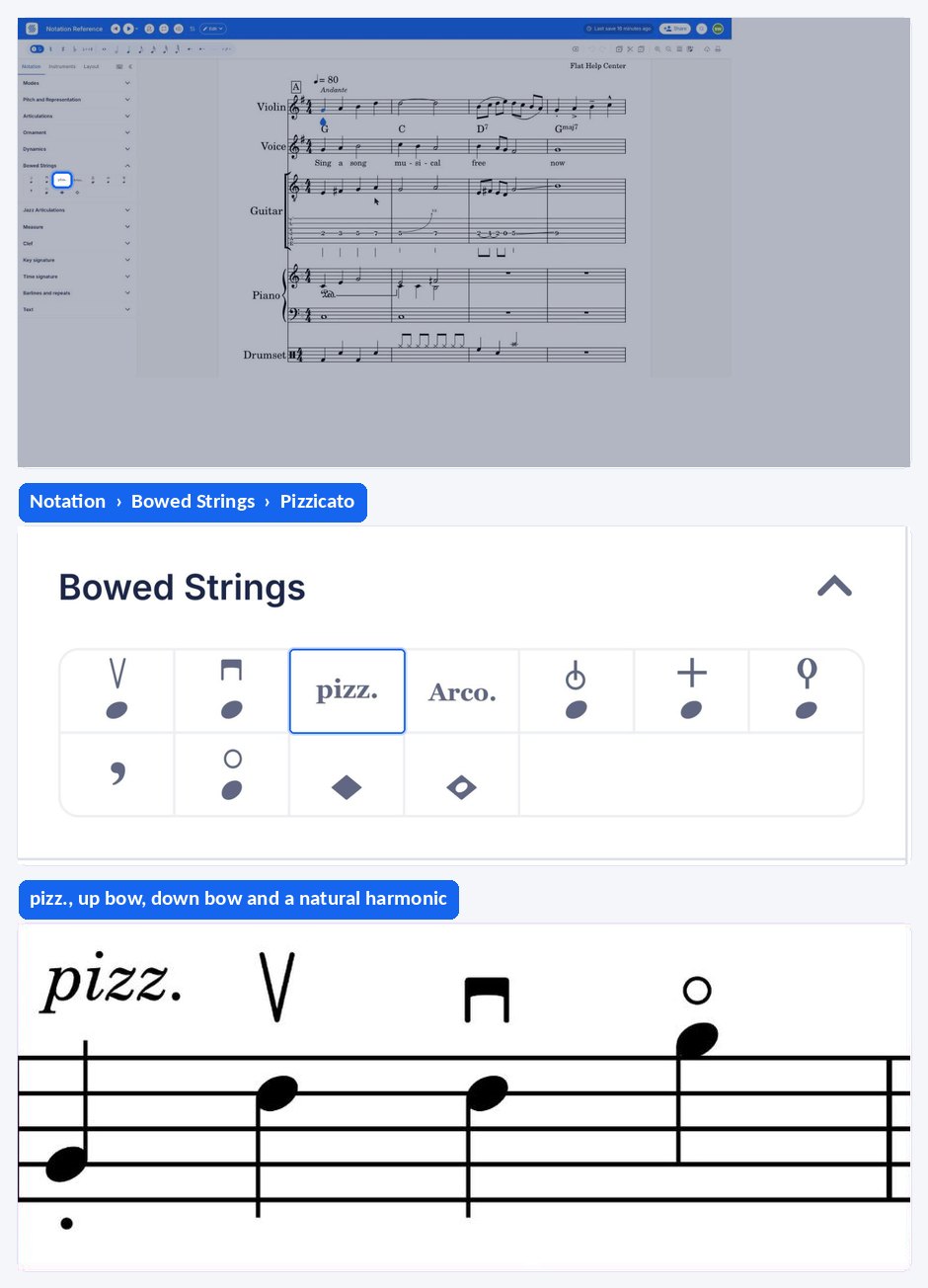
Pizzicato is one of several string techniques Flat notates. See articulations for the full family, and down and up bow markings for bowing instructions.
Which pizzicato markings does Flat offer?
Flat writes three markings for plucked string playing: pizz., arco, and left-hand pizzicato.
| Feature | Icon |
|---|---|
| Pizz | |
| Arco | |
| Left Hand Pizzicato | |
What is a pizzicato?
Pizzicato is a playing technique for bowed string instruments which produces a short and percussive sound. When played, the notes should be plucked with fingers instead of bowed. Arco indicates the end of Pizzicato.
How to add a "pizz."/"arco" notation?
Select the note, drag the tool palette up, and tap Pizz or Arco under Bowed Strings. Flat writes the text above the staff at that note, so the player knows where to start plucking and where to pick the bow back up.
Frequently asked questions
Do I need to add arco after a pizzicato passage?
Yes, whenever the player should go back to the bow. Arco indicates the end of pizzicato, so without it the plucked instruction stands. Select the first note that is bowed again and write the arco marking there, at the start of the passage rather than at the end of the plucked one.
Which instruments use pizzicato?
Pizzicato is a playing technique for bowed string instruments — violin, viola, cello, and double bass. The marking tells the player to pluck the string with the fingers instead of drawing the bow across it, which is why it is paired with arco to return to normal bowing.
How does a pizzicato note sound different from a bowed one?
Plucking produces a short and percussive sound, where bowing sustains the note for as long as the bow keeps moving. That difference is the reason composers switch between the two: pizzicato gives a rhythmic, dry attack that cuts through a bowed texture.
What is the left-hand pizzicato marking for?
It is the third plucked-string marking Flat offers, written the same way as pizz. and arco: select the note and click the left-hand pizzicato button under Bowed Strings. Use it where the part is plucked with the left hand rather than the bowing hand.