How to add octave shifts (8va, 8ba, 15ma) in Flat
Last updated September 17, 2026
An octave shift in Flat displays a passage one or two octaves away from where it sounds, under a bracket marked 8va, 8ba, 15ma, or 15ma bassa. Flat supports all four marks, applies them to a note or a selection, and lets you extend a shift over more notes by dragging it.
Which octave shifts does Flat support?
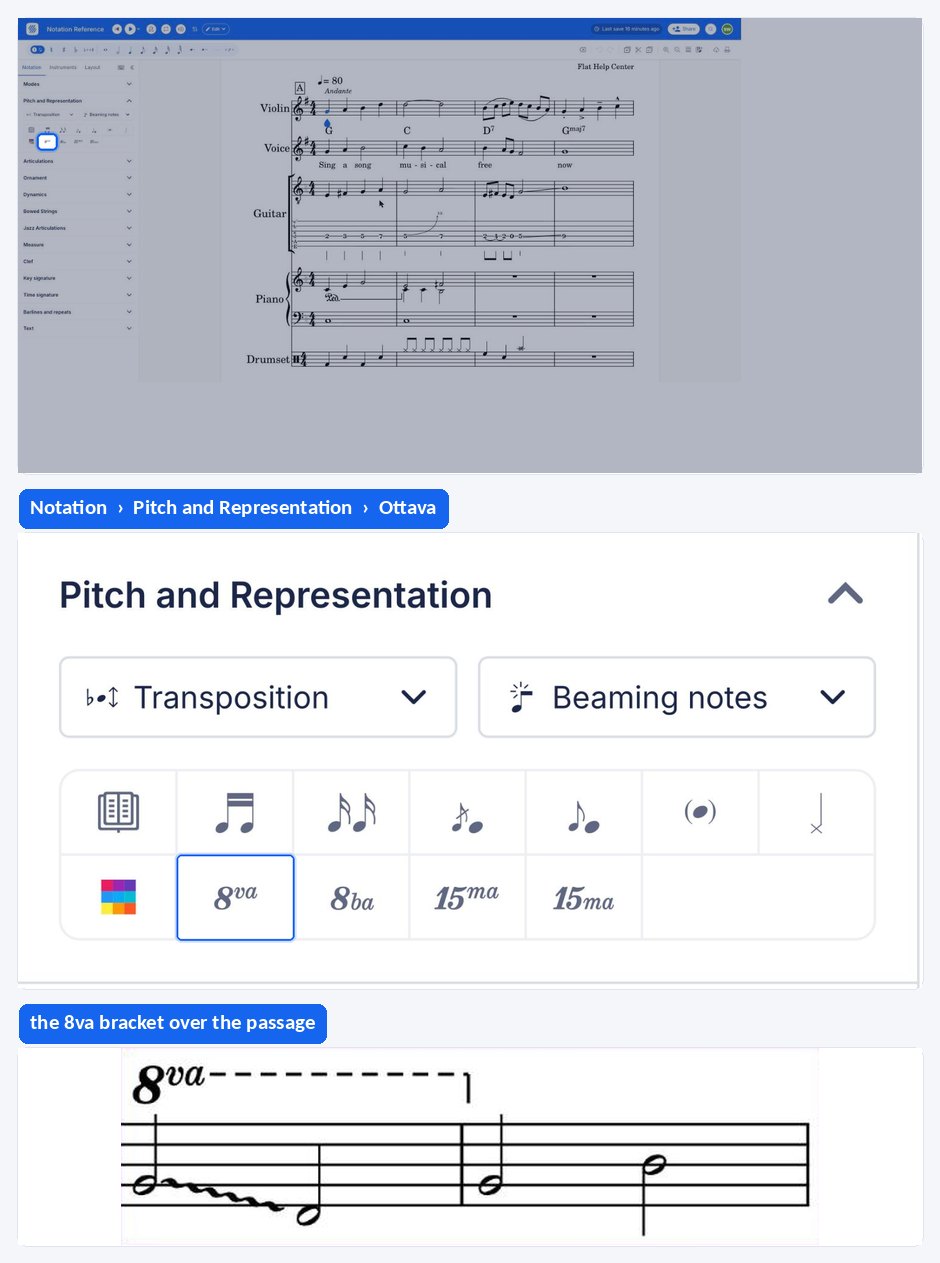
Flat provides the four standard octave marks in the left panel, under the Notation tab, in the Pitch and Representation section. Two shift the passage by one octave, up or down, and two shift it by two octaves.
| Feature | What it does | Icon |
|---|---|---|
| Ottava (8va) | Displays the passage one octave higher |  |
| Ottava Bassa (8ba) | Displays the passage one octave lower |  |
| Quindicesima (15ma) | Displays the passage two octaves higher |  |
| Quindicesima Bassa (15ma bassa) | Displays the passage two octaves lower |  |
How do octave shifts work?
An octave designates the interval between two pitched sounds, one having twice or half the frequency of the other. The difference between the two musical pitches equals the eight notes of a music scale (C D E F G A B C). In music notation, shifting an octave by writing an 8 or a 15 with a line above a section enables clearer reading.
How do I shift an octave in Flat?
Select the notes you want to shift by one or two octaves, then open the Notation tab in the left panel and choose an octave tool under Pitch and Representation: above or below, simple or double. Flat prints the bracket and rewrites the notes at the shifted position.
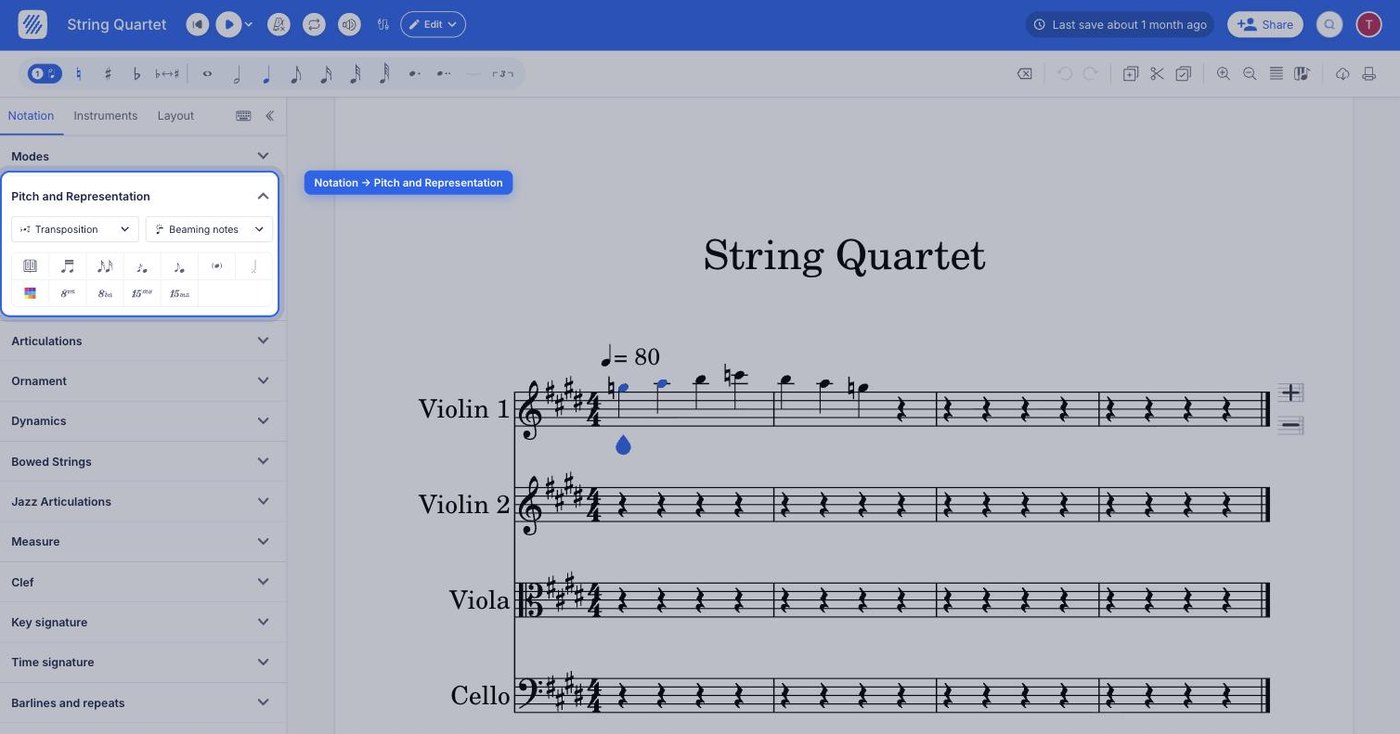
You can extend an octave shift to cover more notes with a simple drag and drop, so there is no need to delete the bracket and start again when the passage grows.
How do octave shifts work?
An octave designates the interval between two pitched sounds, one having twice or half the frequency of the other. The difference between the two musical pitches equals the eight notes of a music scale (C D E F G A B C). In music notation, shifting an octave by writing an 8 or a 15 with a line above a section enables clearer reading.
Which octave shifts does Flat support?
Flat writes the four standard octave marks. Ottava (8va) displays a passage one octave higher and Ottava Bassa (8ba) one octave lower; Quindicesima (15ma) displays it two octaves higher and Quindicesima Bassa (15ma bassa) two octaves lower. All four print a bracket over or under the passage they cover.
How do I shift an octave in Flat?
Flat applies the octave mark you choose to the notes you selected, printing the bracket and rewriting the notes at the shifted position. An octave shift already in the score can be extended over more notes rather than deleted and rewritten.
Select the notes you want to shift, drag the tool palette up, and tap the octave tool you need under Pitch and Representation - above or below, simple or double. Flat prints the bracket and rewrites the notes at the shifted position.
Frequently asked questions
What is the difference between 8va and 15ma?
Both move the printed notes away from where they sound, but by different amounts. 8va displays a passage one octave higher than written and 15ma displays it two octaves higher. The bassa versions, 8ba and 15ma bassa, do the same downwards, which is why a piano bass line often carries 8ba rather than a stack of ledger lines.
Does an octave shift change how the music sounds?
No. The bracket is a reading aid: the passage sounds at the same pitch it would without it. What changes is where the notes sit on the staff, which is the point - a line that would need six ledger lines becomes easy to read under an 8va.
Can I make an octave shift cover more notes after adding it?
Yes. Drag the end of the bracket to extend the shift over the notes you want to include. That is quicker than removing the mark and applying it again, and it keeps the notes already under the bracket exactly as they are.
How is an octave shift different from transposing a part?
An octave shift changes only the way a passage is printed. Transposing changes the pitches themselves, so the music sounds different afterwards. Use an octave shift to keep a line readable, and transposition to move the music to another key or to suit another instrument.