How to switch a note to its enharmonic in Flat
Last updated September 16, 2026
An enharmonic switch in Flat rewrites a note as the other spelling of the same sound - C sharp as D flat, D sharp as E flat. Flat changes only how the note is written, never how it plays, which makes it the tool for getting the notation you want on a staff or a tablature.
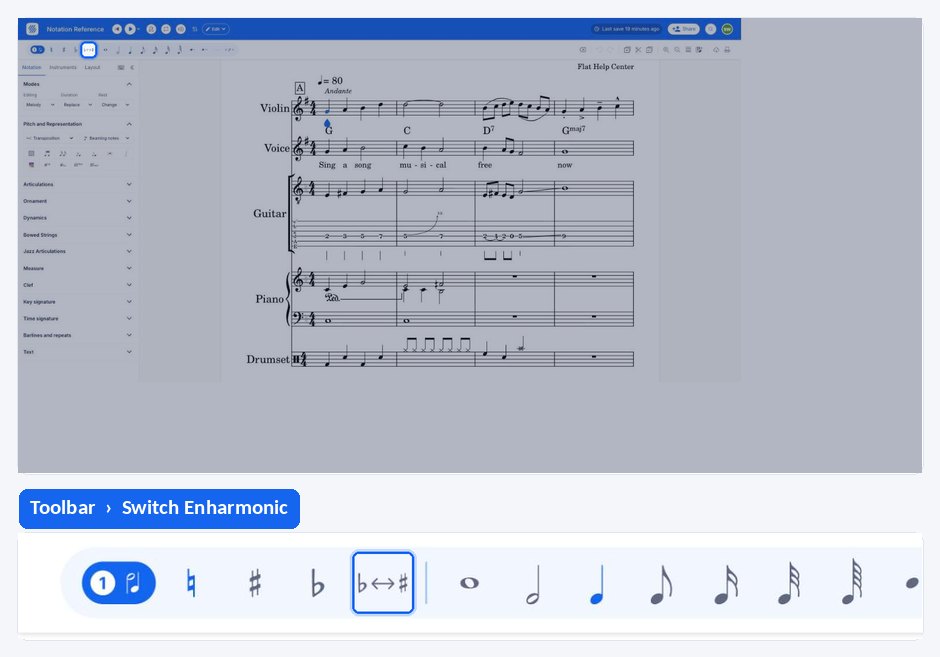
Where is the enharmonic switch?
The enharmonic switch sits in the compact strip above the left panel, next to the accidentals, so it is available whichever tab of the left panel is open. It also has a keyboard shortcut, which is the quickest way to try both spellings of a note while writing.
| Feature | Icon | Keyboard shortcut |
|---|---|---|
| Switch Enharmonic |  | J |
What does the enharmonic switch do?
The enharmonic switch changes the selected notehead for another one that has the same sound. C and B sharp have the same sound, and so do D sharp and E flat. The tool is useful when you are inputting notes from a TAB staff and want a particular visual display.
As you can see in the image below, the two notes are played on the same string and fret.
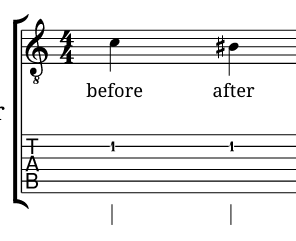
An enharmonic switch is a spelling change only. Playback, the fret and string on a tablature, and the note's position in the harmony all stay exactly as they were.
Frequently asked questions
What does enharmonic mean?
Two notes are enharmonic when they sound the same but are written differently. C sharp and D flat are the same pitch on a keyboard and the same fret on a guitar, yet each belongs to a different key and reads differently on the staff. Choosing between them is a notation decision, not a sound one.
Does switching the enharmonic change how the note sounds?
No. The switch affects the printed spelling only. The pitch, the playback, and the string and fret used on a tablature are unchanged, which is why the tool is safe to use purely to make a passage easier to read.
Why does my tablature show a note I did not expect?
Because the spelling you entered determines how the note is displayed even when several spellings share a fret. Applying the enharmonic switch to the note gives you the other spelling without moving it, which is the usual fix when entering notes from a TAB staff.
What is the difference between switching the enharmonic and adding an accidental?
An accidental raises or lowers a note, so it changes the pitch you hear. An enharmonic switch keeps the pitch and rewrites it with the other spelling, which usually means swapping a sharp for a flat and moving the notehead to the neighbouring line or space.